I was sad to see the news of Martin Parr’s death yesterday. I have come to appreciate and enjoy his work, much of which was documenting the ‘tasteless cheerfulness’ of what he saw. His work has been controversial at times, from his ‘signature’ use of bright colour to the subjects he chose. I never found his work quite as cruel or intrusive as that of some photographers, feeling that the images were underpinned by a wry affection for our collective human foibles – along with a good eye for the ridiculous.
I worked for a number of years in the Black Country and thoroughly enjoyed his Black Country Stories; I felt the engagement he had with the subjects and community did shine in this. (So sad that The Public, the art gallery where the exhibition was held, and which did much to develop public engagement with the arts, was closed not long after.)
His Oxford series also resonated, having studied there (in the days when women were only 1 in 10 of the student population which was even more public-school dominated than today). Other work I enjoy in a less personal way and there is some, as with every artist, that doesn’t move me particularly or that I don’t take to, for whatever reason, but still may admire.
One set of images however, simply stopped me in my tracks, ten years ago now. We went to the splendid Compton Verney gallery to see The Non-Conformists, a very early body of work he compiled with Susie Mitchell, later his wife, from 1975 – 80. Her words, combined with his images captured some local, disappearing communities and their lives, the Hebden Bridge ‘chapel’ folk much like our family and those I grew up with in the nearby Halifax area, our lives puctuated by the Methodist chapel calendar, from Boys’ Brigade nights to fetes and fundraisers via two services and Sunday School classes every Sunday. My oldest memories are from almost two decades earlier, but the lingering vestiges of that world are here for me, vivid as ever.
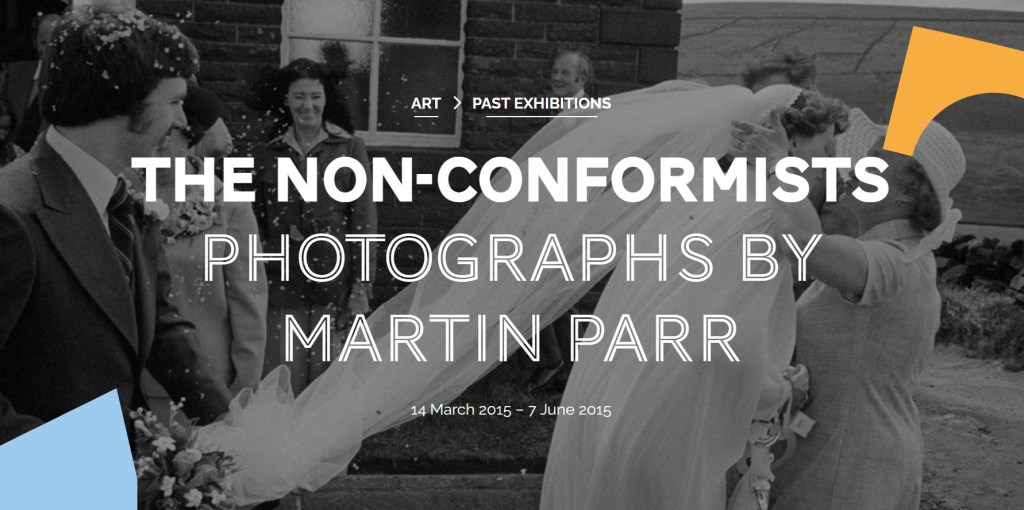
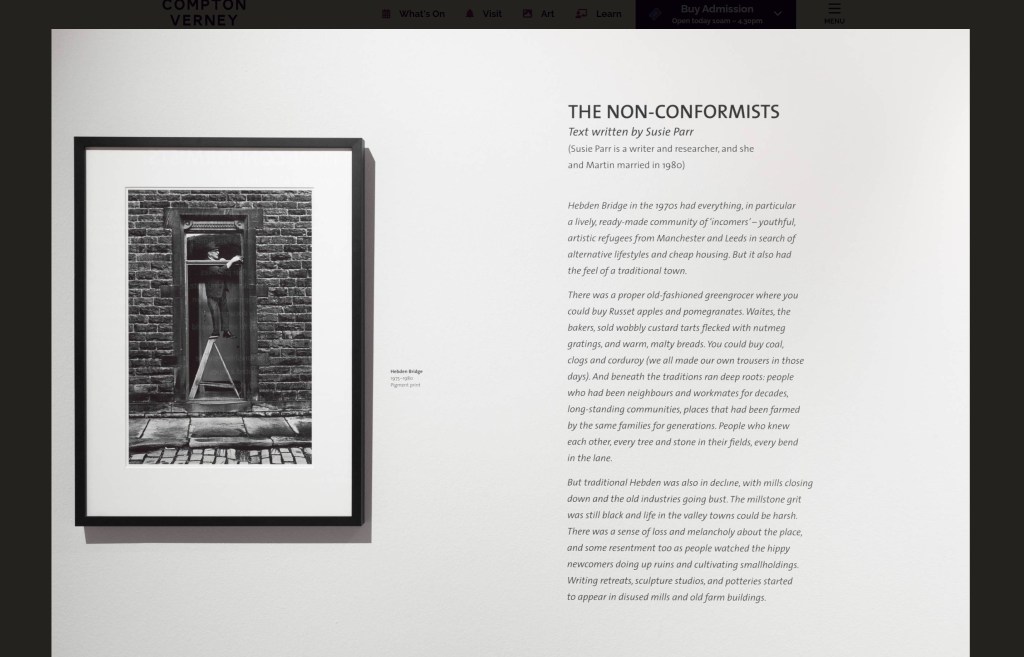
To younger people or those hailing from very differing communities this might mean nothing but a passing monochromatic glance into a now-distant past. To my eternal surprise, I found myself being literally reduced to tears as I ‘recognised’ the essence of family and friends in the the chapel stalwarts at the Anniversary celebrations and preparations (recalling my great-aunt’ s serious Sunday hat and rag rug made of family memories), remembering freezing at a cousin’s winter wedding at a moor-top chapel, and a furtive tear even rolled down my cheek at the gentleman nonchalantly perched one-legged on the stepladder, dapper in his suit, tie and hat, cleaning the fanlight glass above his front door, an unwitting representative of an entire generation and lifestyle captured for posterity.
I didn’t just see those chapel interiors, I could smell again the faint lingering dust, polish and flower scents, hear echoes of rousing Wesleyan tunes and wheezy organ, see the sidesmen with the wooden collection plates… The exterior shots brought with them a smell of chimney smoke, November fog and damp woollen coats.
If Martin Parr had taken no more images than these, he would have left a creditable and significant piece of history and ‘done right by’ those Yorkshire Non-Conformists he and Susie documented. Yet this was only the start. How many others will look at his collections and feel that visceral reaction of recognition of a vanished or vanishing community? Not to mention the wry smiles and generous laughter with, rather than at, some of the absurdities of life then, as now.
Have a nice rest, Martin.
INT
You’re obviously not afraid of death, are you?MP
Not particularly, no. It would be a nice rest.



 Random Thoughts