
I noticed it is the anniversary of my paternal great-grandfather’s death today and realised I have little or no understanding of him as a person and scant information beyond censuses and basic records. In part, this is no doubt because his son, my grandfather, died when my dad was only 4, and there seems to have been no connection maintained with the rest of the family at the time, though some reconnection took place in recent decades, thanks to a half-cousin’s genealogy interest. In part it is also that he was a working-class man in a busy, growing city, no doubt with little leisure, and few chances to make more of a mark given his place in society. He did, though, have a family who left their imprints in various ways.
I thought I’d just take a few minutes to review the bare bones that I do have as a little recognition of Frank and see if I can flesh them out a little more in future.
Frank Edmund Dobson was born on 6 May 1851 at 5 Holborn St, West Derby, Lancashire, to John, a basketmaker and Mary, née Copson and a ribbon weaver when they married. Frank was baptised at the Parish Church of St Peter’s, Liverpool on 26th May 1851.
In 1863, when he was 12, he lost his younger brother, Ishmael Alfred, aged only 9, of chronic bronchitis and his mother, Mary died at 6 Hanover Street of phthisis (TB, also then rife) the following year, so he knew loss at an early age, as so many did then.
In 1871 Frank is still living at 6 Hanover Street with father John, older sister Hagar and 2-year-old nephew John Wm Ernest (son of Frank’s elder brother John).
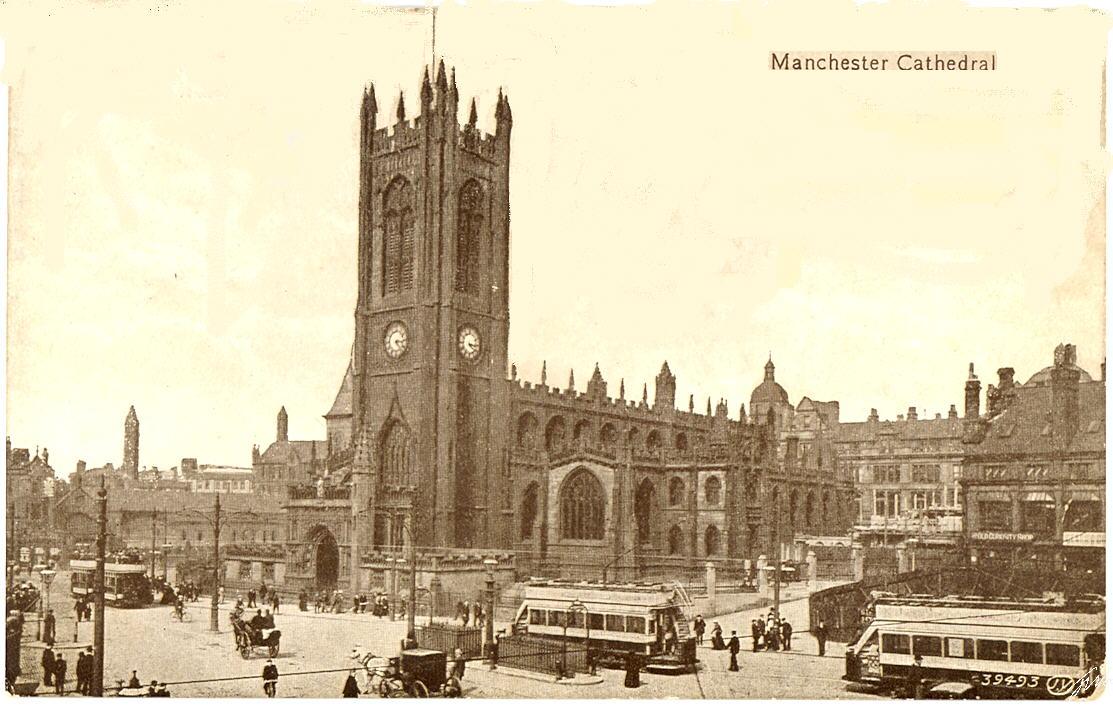
Frank married Jane Elizabeth Ellen Chadbourne on 27th April 1873 at the Cathedral and Parish Church (St Mary, St Denys & St George) in Manchester. Jane’s address on the marriage registration is 6 Holborn Street and Frank’s given as Buckingham Street – whether accurate or to apparently preserve the proprieties I do not know. He is a skip maker, as is his father John. Elizabeth’s father, another John, is listed as a labourer.
I also don’t know how they had met: Jane, born and brought up in Worcestershire, quite near where I now live, was to be found in Bishop Wearmouth, Co Durham in 1871 (as Jane Chadburne), and presumably stayed in the north from that point on. The little I know of her story I will tell under her own name, not here.
Their first child, John William Ernest (JWE presumably named after brother John’s firstborn above who had died of typhus aged 4 in 1873) was born in March 1874. They were then living at 10 Miller Street, and JWE was baptised on 4 April 1875 at the United Methodist Chapel. (He lived, I hope, happily, to 1956, dying in Suffolk shortly after his wife.)
Second son Frank Milton Edmond Dobson came along in 1876 and was duly baptised at the United Methodist Free Church in Lever Street, but sadly died aged 4 and was buried in Cheetham Hill Wesleyan Cemetery in June 1880.
Third child David Livingstone Dobson was born in 1878, and survived to age 50, remaining in Salford apart from active service in South Africa in the Second Boer War.
Fourth son Harry was born in 1881 when the family was at 1 Bagshaw Court and, like David L, went to serve as a Private in South Africa. Sadly, he died there of fever (like some two-thirds of the casualties) on 19 April 1900 and was buried in Ladysmith. His name is on a commemorative plaque in Manchester Cathedral, and the memorial in St Ann’s Square and a couple of others – poor consolation to his family but still there to this day.
They had four more children after Harry; their first daughter, Mary Annie Dobson was born on 1 March 1883 and died on 5 October 1883 in Cheetham Clinical Hospital, Lancashire, when she was 7 months old. Her father registered the death the next day.
My grandfather Frank Milton Dobson arrived on 3 September 1884 and though he died at quite a young age, he survived his parents by some years.
Harold Chadbourne Dobson, born 8 Jan 1890 and baptised at the Cathedral in February, survived WW1 and died in Leeds in 1949. My father was actually studying in Leeds at that time but I think was totally unaware of his uncle nearby, sad to say.
Youngest child and only surviving daughter Agnes May Gibbons Dobson arrived on 29 November 1897 when her mum Jane was 45 and Frank 46. She was baptised at Manchester Cathedral on 16 January 1897.
Agnes was only 12 when she lost her dad and still a young woman of only 21 when her mother died. I was pleased to find that she lived until 1972, resident at the end of her life in Lytham St Anne’s where my parents had honeymooned a couple of decades earlier again, unaware of her existence.
Frank Edmund had lost his own father John in 1894 in very distressing circumstances. Death certificate, inquest and newspaper articles reported that retired skip & basket maker John, late of 8 Cross Lane, died in Salford Royal Hospital of burns on his feet, legs, hands & body caused by “his clothing & some bedding getting on fire”. He lived for 29 hours – one can only hope with adequate sedation. Accidental death was certified by Fred: Price, Coroner for the County Borough of Salford.
To round this section up on a more cheerful note, Frank did live to see their son David married to Janet Haddow Scobie in August 1904 at St Thomas’ Church, Seaforth and JWE and Mary Agnes had given him surviving grandchildren.
Frank Edmund was living at the family home at 14, Choir Street, Broughton, Salford (and had been there since at least 1900) when he died of consumption, aged 57. The certificate shows Phthisis pulmonalis and Exhaustion as causes of death, as they were for many in our industrial cities. His passing was registered on 11 January by Jane, who was also present at his death. This last detail pleases me – they had gone through so much together and I am so glad he didn’t die alone.
He was buried in the Wesleyan Cemetery at Cheetham Hill, Manchester on 13 January 1909, to be rejoined by Jane 9 years later.
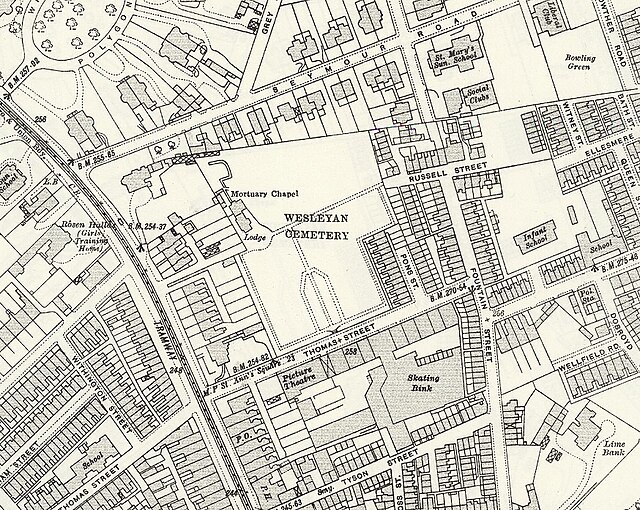
The graveyard was built over after a controversial removal of the remains.



 Random Thoughts